How to Bid a Commercial Cleaning Contract, Step by Step
Quick answer
A winning bid has eight parts. You qualify the client, then walk the site and write the scope of work by area and frequency. You turn square feet into labor hours, price the month from your costs, check the result against typical ranges, and send a short proposal. Then you follow up on a set date and track your real hours after you win. Most lost money comes from skipping the walkthrough or the hours step.
Commercial contracts pay every month, which makes them attractive. They also lock you into a price for a year or more. A bid that is $200 too low each month costs you $2,400 a year, and you will not notice until you look at your hours.
Here is a bidding process you can repeat for every site.
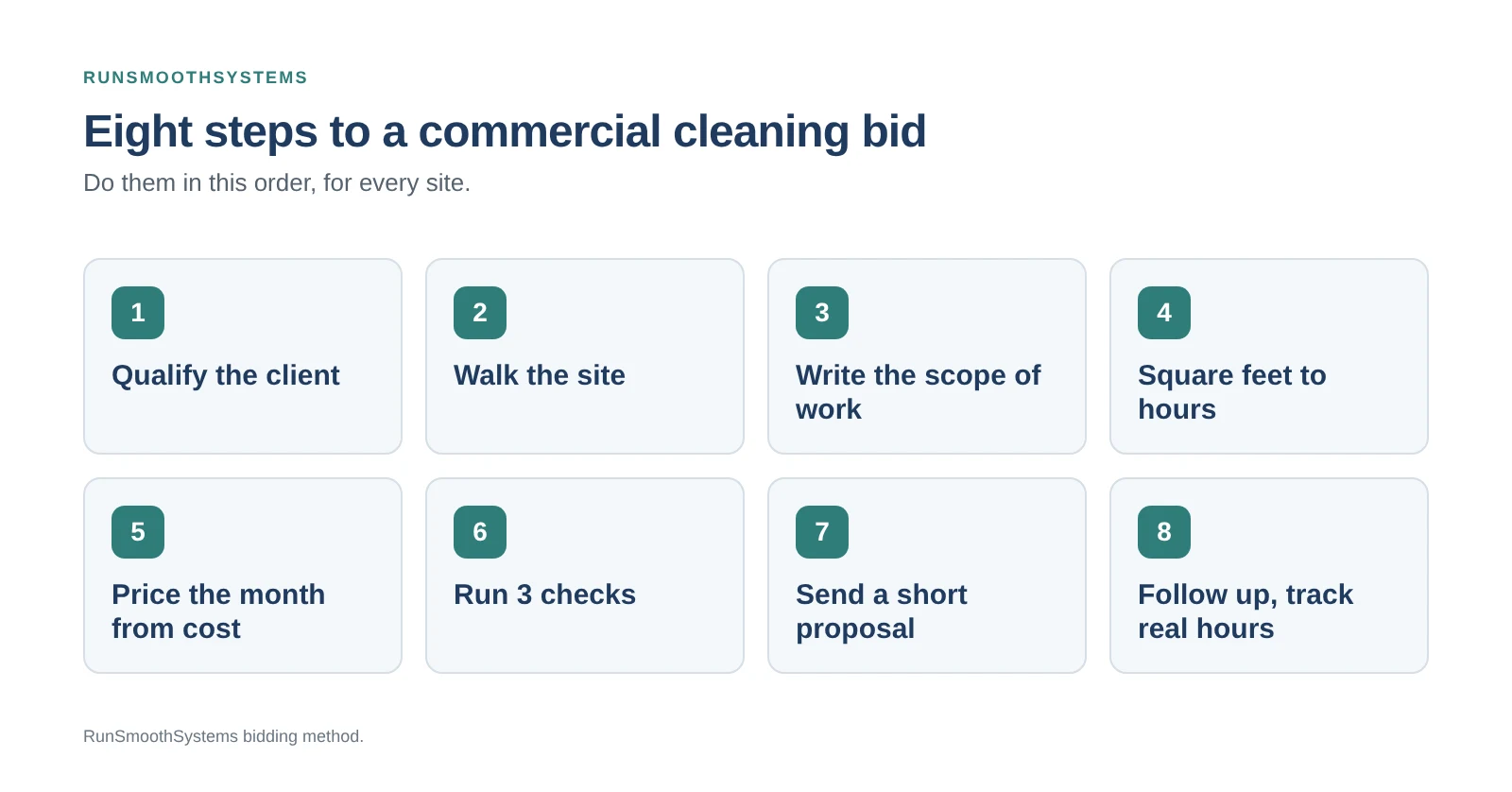
Step 1: Qualify the opportunity
Before you drive anywhere, ask four questions by phone or email:
- What type of facility is it, and roughly how many square feet?
- How many days a week do they want cleaning, and at what time?
- Who cleans it now, and why are they looking?
- When do they want to decide, and who signs?
The third answer tells you a lot. "Our cleaner keeps missing the restrooms" is a quality problem you can solve. "We want it cheaper" is a price-only buyer. Decide if you want that contract before you spend an hour on it.
Step 2: Walk the site
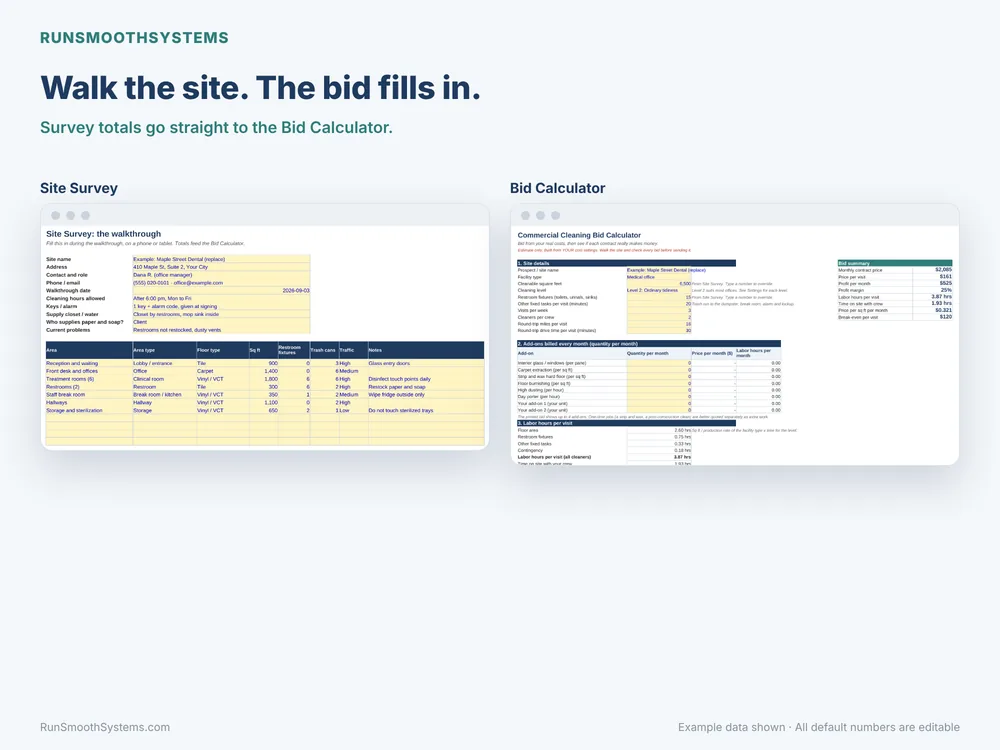
Never price a commercial site from a phone call. During the walkthrough, record:
- Cleanable square feet, by area (offices, hallways, break room, restrooms)
- Floor types: carpet, hard floor, tile
- Restroom fixtures: toilets, urinals, sinks
- Trash points and recycling
- Access: keys, alarm codes, after-hours entry, parking
- Anything special: glass doors, kitchen appliances, lobby, stairs
Use the same survey sheet every time, so you never forget a line.
Step 3: Write the scope of work
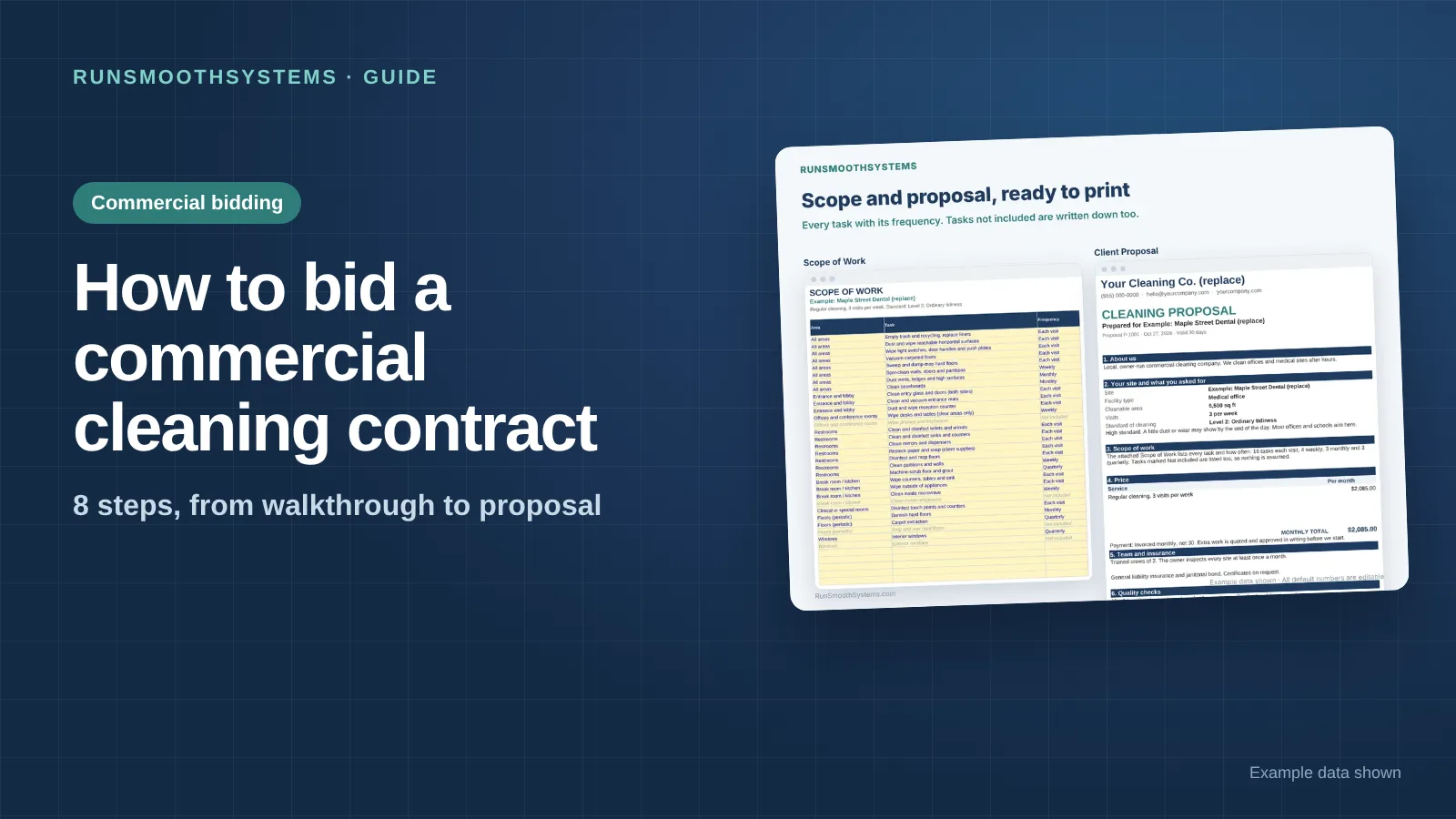
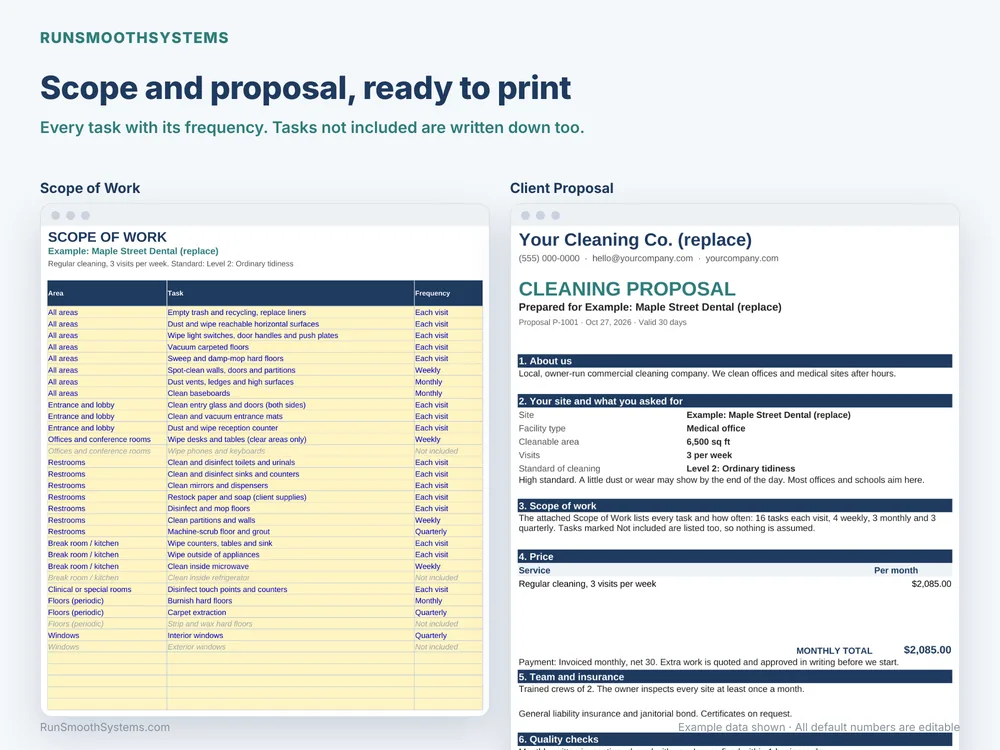
The scope of work is the list of every task and how often you do it: each visit, weekly, monthly or quarterly. It protects both sides. The client knows exactly what they pay for, and you have a clear answer when someone asks "can you also do the fridge?"
Write it by area and frequency. For example:
| Area | Task | Frequency |
|---|---|---|
| Restrooms | Clean and disinfect toilets, urinals and sinks | Each visit |
| Restrooms | Refill soap, paper and liners | Each visit |
| Offices | Empty trash and replace liners | Each visit |
| Offices | Dust desks and reachable surfaces | Weekly |
| Hard floors | Damp mop | Each visit |
| Carpet | Vacuum traffic lanes | Each visit |
| Carpet | Full vacuum including edges | Weekly |
Anything not on the list is extra work, quoted and approved in writing before you do it.
Step 4: Turn square feet into labor hours
Use a production rate (square feet one cleaner cleans per hour) for each type of area, adjusted for the cleaning level the client wants. Add restroom time per fixture if your production rate does not already include it.
Hours per visit = Cleanable sq ft ÷ Production rate × Level factor
In our example office of 6,000 sq ft at a starting rate of 3,000 sq ft per hour, that is 2 labor hours per visit. Time your own crew on the first visits and correct the rate. We explain production rates in more detail in our price per square foot guide.
Step 5: Price the month from your costs
Add up labor (with payroll taxes and insurance), paid travel, vehicle, supplies and overhead for one month, then apply your margin:
Monthly price = Monthly cost ÷ (1 − target margin)
With 3 visits a week (13 a month), the example costs come to $975.32 per month, and a 25% margin gives a price of $1,300.43 per month. That is about $100 per visit.
Step 6: Run three checks before you send it
- Profit: is the monthly profit worth the risk and your time?
- Price per square foot vs the typical range: for offices, ISSA's December 2025 guideline is $0.09 to $0.17 per sq ft. Our example is $0.217, above the range, because the site is small and gets 3 visits a week. That is fine if you know why.
- Below cost: make sure no add-on or discount pushes any line below your cost.
Step 7: Send a short proposal
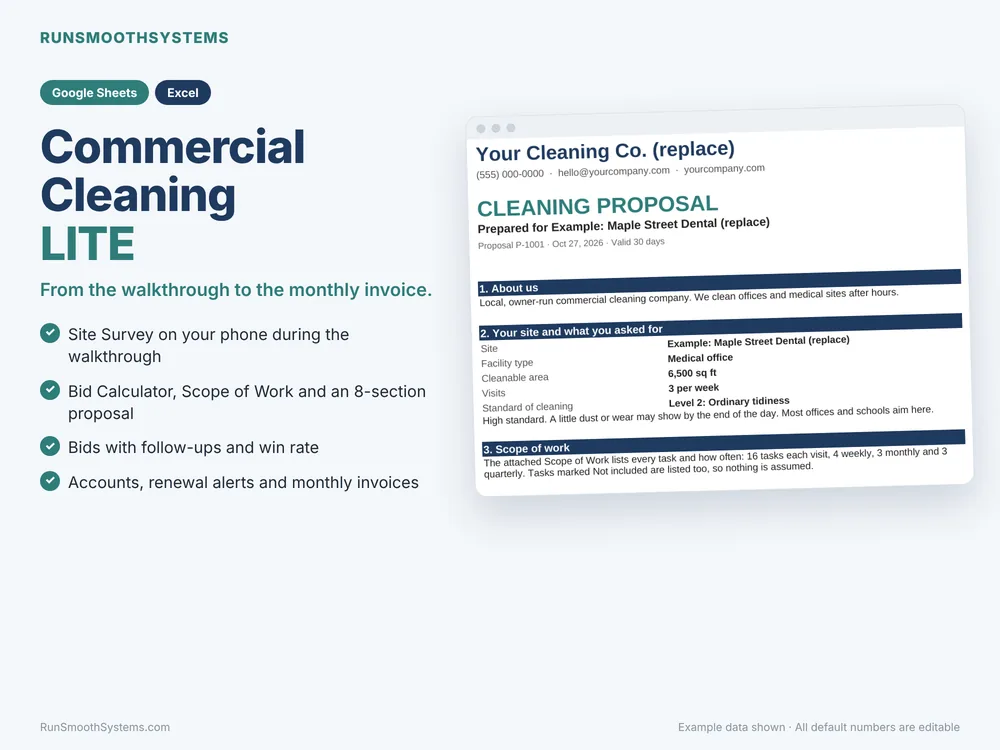
Busy facility managers do not read 20 pages. A proposal of one or two pages, in eight short sections, is enough:
- About us
- Your site and what you asked for (type, area, visits, cleaning standard)
- Scope of work (attached, with task counts per frequency)
- Price (monthly total, plus any approved add-ons)
- Team and insurance
- Quality checks (how and how often you inspect)
- References
- Next steps (sign or reply by email, sign the service agreement, first clean date)
Put the monthly price in one clear place. State that extra work is quoted and approved in writing before you start.
Step 8: Follow up, then track your real hours
Set a follow-up date when you send the bid, and write it down. When you lose, ask why, politely. Over time your win rate tells you if the problem is your price or your pitch.
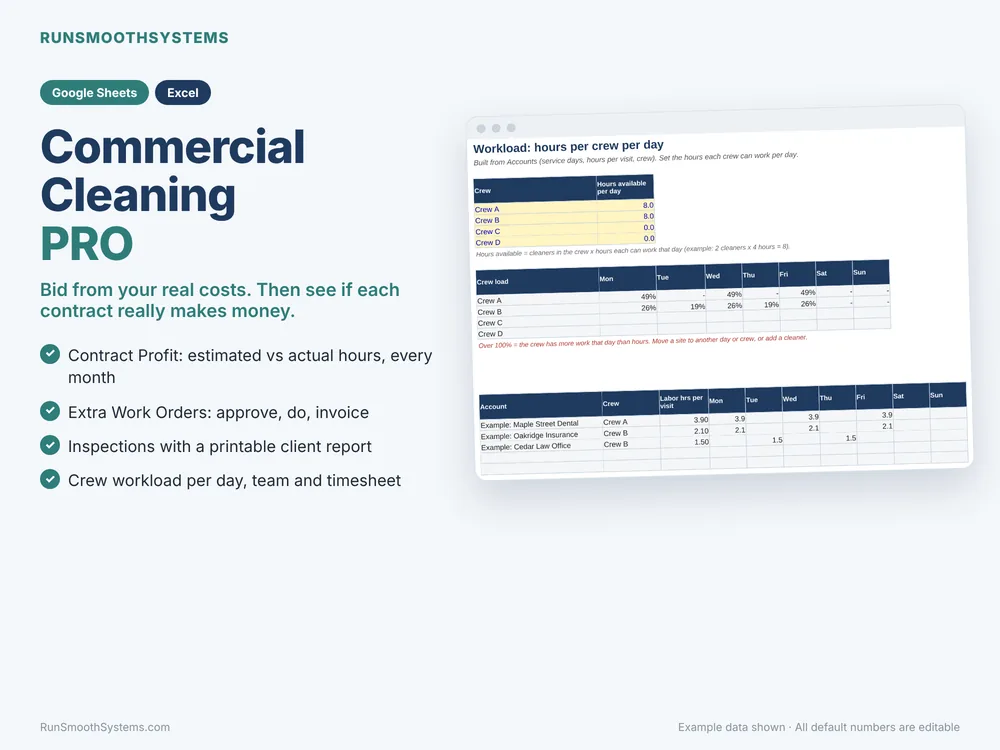
After you win, compare estimated hours with actual hours every month. If a contract regularly takes more time than you priced, you have three options: improve the routine, agree extra paid work, or re-price at renewal. Mark the renewal date at least 60 days ahead so you can review the price in time.
Common bidding mistakes
- Pricing from a phone call. You miss restrooms, floors and access problems.
- Forgetting travel. Small sites far apart can eat your whole margin.
- No written scope. Every "small favor" becomes free work.
- Adding a markup instead of a margin. 25% on top of cost is not a 25% margin.
- Never checking actual hours. The contract drifts into a loss without anyone noticing.
Frequently asked questions
How long should a commercial cleaning proposal be?
One or two pages plus the scope of work is enough for most small sites. Make the price, the scope and the next step easy to find.
Should I include supplies like paper towels and soap?
Say it clearly either way. Many contracts have the client supply consumables, with the cleaning company supplying chemicals and equipment. If you supply consumables, price them separately.
How do I bid if I have never cleaned that type of building?
Use a conservative production rate, add a short time buffer, and say in the proposal that you will review hours after the first month. Then time every visit.
What if the client says my price is too high?
Ask what they compare it with. Then offer a lower frequency or a reduced scope, instead of the same work for less money.
Do I need a contract?
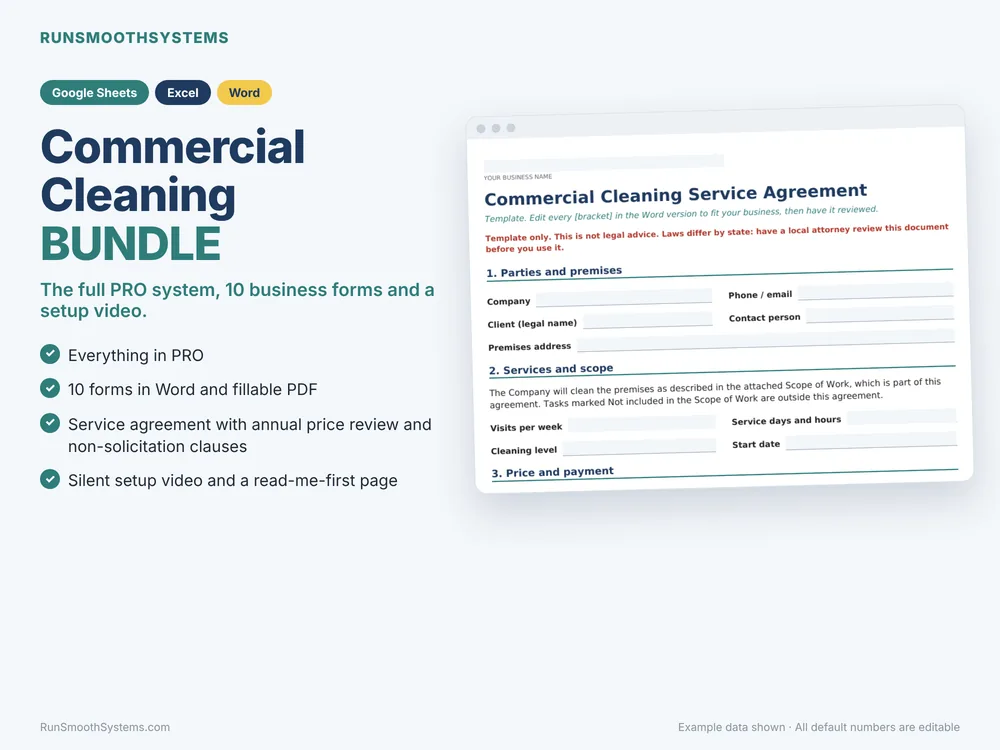
A signed service agreement protects both sides. Templates help you start, but have a local professional review any agreement you rely on.
Example numbers in this guide are for illustration. Use your own costs. This is not legal, tax or accounting advice.
Sources
- ISSA, Commercial cleaning rates per square foot, December 4, 2025.