How Much to Charge for House Cleaning: The Cost-First Formula
Quick answer
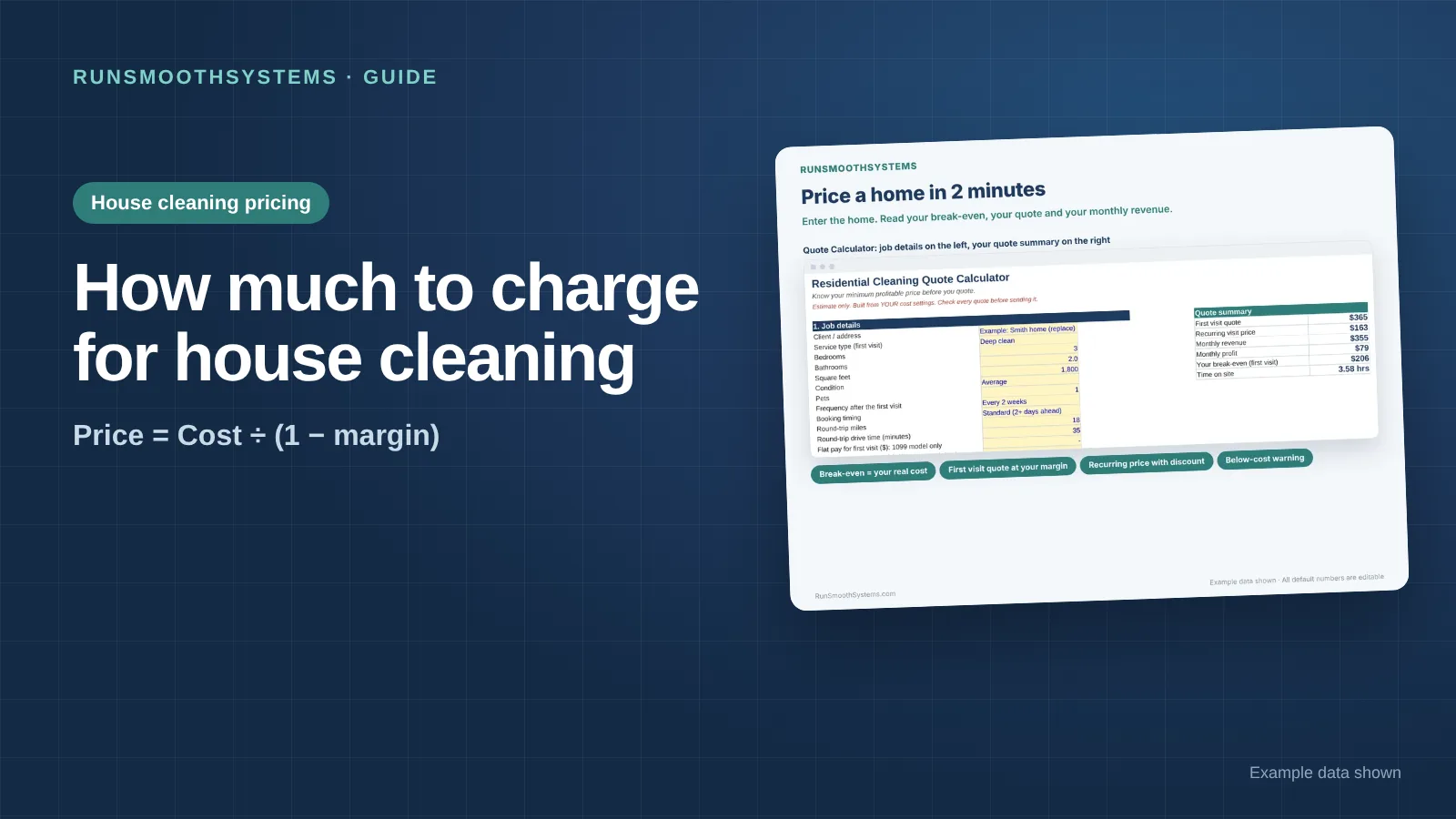
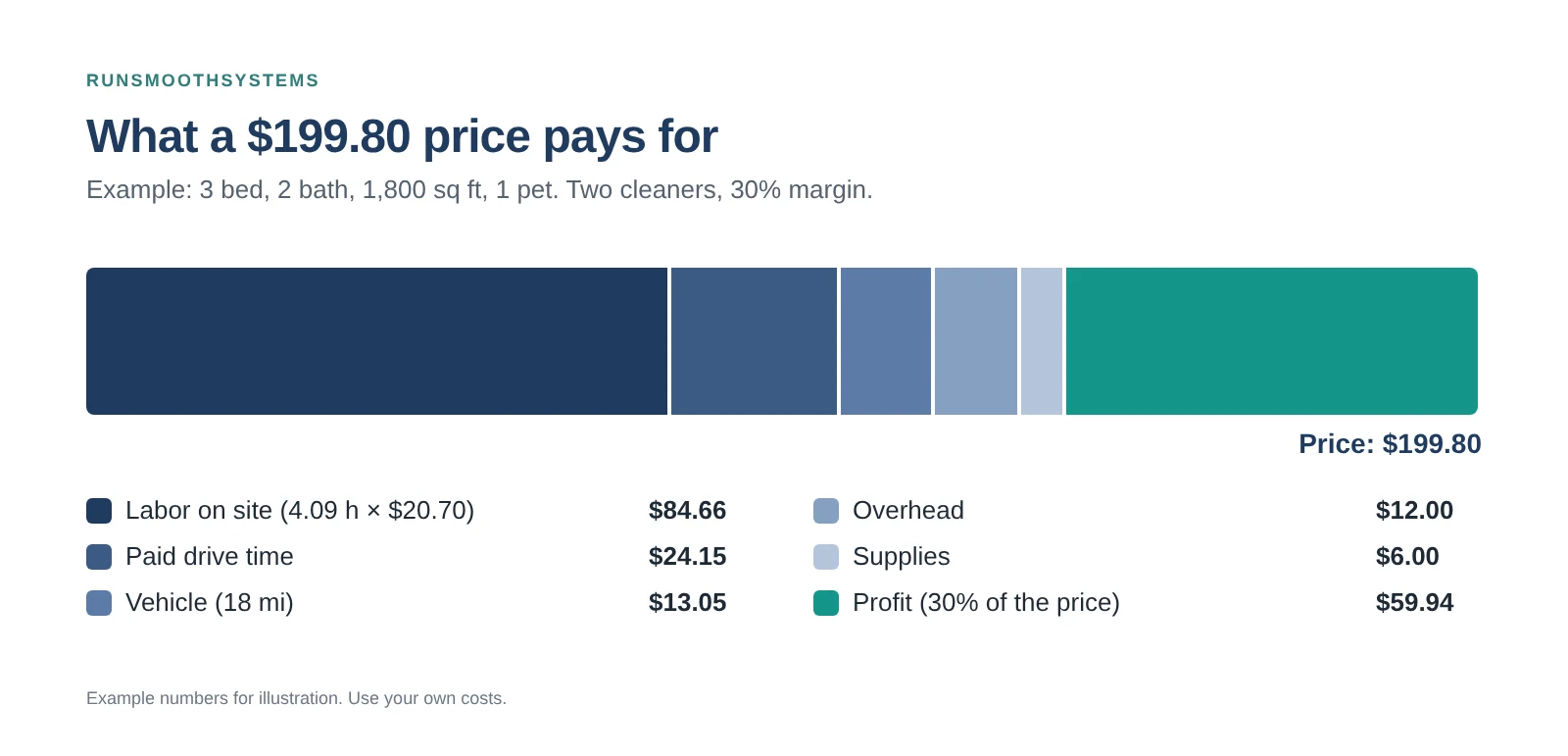
Add up what the job costs you (labor with taxes, drive time, supplies, vehicle and overhead), then divide by 1 minus your target margin. A 3-bed, 2-bath, 1,800 sq ft home with the example costs below comes to about $140 in cost and about $200 at a 30% margin. Then check that number against local prices.
Price = Total job cost ÷ (1 − target margin)
Most new owners set prices by looking at what others charge. That tells you what clients pay. It does not tell you whether you make money at that price. Your wage, your drive, your supplies and your overhead are different from the company down the street.
This guide shows the method we build into our templates: start from your own costs, add your margin, and only then compare with the market.
Step 1: Estimate the time on site
Time is the biggest cost in house cleaning, so estimate it first. A simple time model uses the size of the home:
| Part of the home | Example time |
|---|---|
| Base time per visit (setup, walk-through) | 0.5 hours |
| Each bedroom | 0.33 hours |
| Each bathroom | 0.5 hours |
| Each 1,000 sq ft | 0.75 hours |
| Pets in the home | 0.25 hours |
For a 3-bedroom, 2-bathroom, 1,800 sq ft home with one pet, that is about 4.1 cleaner-hours on site. With a team of two, each cleaner works about 2 hours.
These are example values, not industry data. The fastest way to get your own is to time your next three standard cleans and adjust the numbers until the estimate matches reality.
Step 2: Turn hours into labor cost
Your labor cost is more than the wage. If your cleaners are employees, you also pay payroll taxes and usually workers' compensation insurance. The IRS sets the employer share of Social Security at 6.2% and Medicare at 1.45%. Federal and state unemployment taxes and insurance come on top, and they vary by state.
A simple way to handle this is a labor burden: a percentage you add on top of the wage.
Loaded hourly cost = Wage × (1 + labor burden)
With an example wage of $18 per hour and a 15% burden, one cleaner-hour costs you $20.70. Ask your accountant for your real burden. If you work with 1099 subcontractors and pay a flat amount per job, use that amount as your labor cost instead.
Step 3: Add drive time and the vehicle
Drive time is the cost owners forget most often. If you pay your team for driving, add it to labor:
- 35 minutes round trip × 2 cleaners = 1.17 paid hours × $20.70 = $24.15
Then add the vehicle. The IRS publishes a standard business mileage rate every year. Our templates use the 2026 rate of 72.5 cents per mile as a default. Check irs.gov for the current rate.
- 18 miles round trip × $0.725 = $13.05
Step 4: Add supplies and overhead per visit
Supplies: take one month of supply spending and divide it by the number of jobs you did that month. Our example uses $6 per standard visit.
Overhead: this is everything you pay even when nobody is cleaning: insurance, phone, software, advertising, bank fees, your own office time. Take your monthly overhead and divide it by your jobs per month. Our example uses $12 per visit.
Step 5: Add up the cost and apply your margin
Here is the full example:
| Cost line | Amount |
|---|---|
| Labor on site: 4.09 hours × $20.70 | $84.66 |
| Paid drive time: 1.17 hours × $20.70 | $24.15 |
| Vehicle: 18 miles × $0.725 | $13.05 |
| Supplies | $6.00 |
| Overhead | $12.00 |
| Total cost of the job | $139.86 |
| Price at a 30% margin: $139.86 ÷ 0.70 | $199.80 |
The profit on this job is about $60, which is 30% of the price.
Why divide instead of multiply?
Many owners add 30% on top of cost: $139.86 × 1.30 = $181.82. That looks like 30% profit, but it is not. The profit is $41.96, which is only 23% of the price. Dividing by (1 − margin) gives you the margin you actually asked for. We explain the difference in our profit margin guide.
Step 6: Set a minimum price
Small jobs can lose money even with the formula, because drive time and overhead stay the same. A minimum job price protects you. Our templates use $120 as an example minimum. Pick yours from your real costs: what is the smallest job that still covers a round trip and your overhead?
Step 7: Compare with your local market
Now look at what clients pay. On Thumbtack's price guide (updated October 20, 2026), the national range for a 3-bedroom home is $166 to $250. Our example price of about $200 sits inside that range.
What the comparison tells you:
- Your price is inside the range: good. You know your profit, and clients will not be surprised.
- Your price is above the range: check your time estimate first. Then check drive time. If both are right, you may need a higher-value service mix, a smaller service area, or a minimum price, not a lower margin.
- Your price is below the range: you may be leaving money on the table. Raise it toward the local level and keep the extra margin.
National ranges are averages. Your city can be very different, so ask a few local clients or look at local listings too.
Recurring clients and frequency discounts
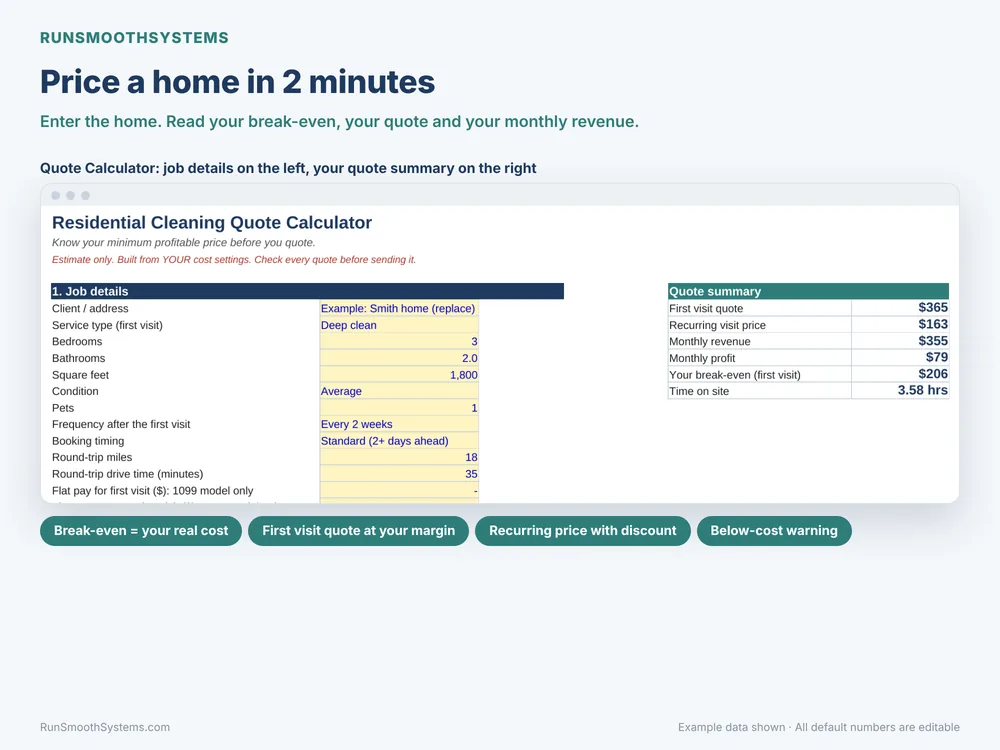
Recurring visits are usually faster once the home is caught up. Our example sets a recurring visit at 85% of the first-visit time. The same home then costs about $127 to clean and prices at about $182 at a 30% margin, before any frequency discount.
If you give a discount for weekly or every-two-weeks service, apply it to that recurring price and check that the margin is still where you want it. A discount that feels small can take a big bite out of a 30% margin.
Put it on a quote the client understands
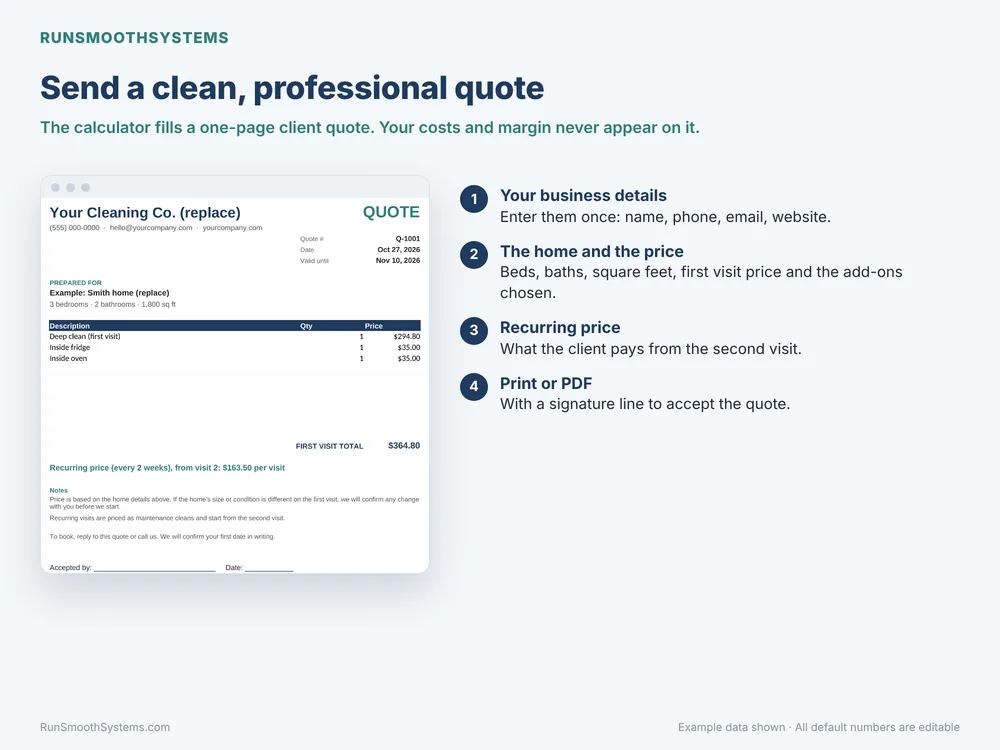
Clients do not need to see your costs. They need one clear price, what is included, and what costs extra. A one-page quote with your business name, the price for the first visit, the recurring price and your add-ons is enough.
Frequently asked questions
Should I charge by the hour or a flat rate?
Most clients prefer a flat price because they know the total before you start. You can still build the flat price from hours, as in this guide. See our [flat rate vs hourly guide](/blog/flat-rate-vs-hourly-cleaning-pricing/).
What margin should a house cleaning business aim for?
There is no single correct number. Our example uses 30%. Pick a margin that covers your own pay if you are not on payroll, slow months and growth. Then check it job by job.
How do I price without seeing the house?
Ask for bedrooms, bathrooms, square feet, pets and the condition, and ask for a few photos. Price the first visit from that, and tell the client the price can change if the home is very different from the description.
Do I need to charge more for the first visit?
Usually yes. The first visit takes longer because the home is not yet at maintenance level. Price it from its own time estimate, then price recurring visits separately.
How often should I update my prices?
Check your costs at least every few months and whenever your wages, fuel or insurance change. Time a few jobs again and adjust.
Example numbers in this guide are for illustration. Use your own costs. This is not legal, tax or accounting advice.
Sources
- IRS, Topic 751: Social Security and Medicare withholding rates, employer rates 6.2% and 1.45%. Opened October 30, 2026.
- Thumbtack, House cleaning prices, updated October 20, 2026. National cost by bedrooms.
- IRS standard mileage rates: check irs.gov for the current year.